
BACK TO ARTICLES & BLOGS
Loading...
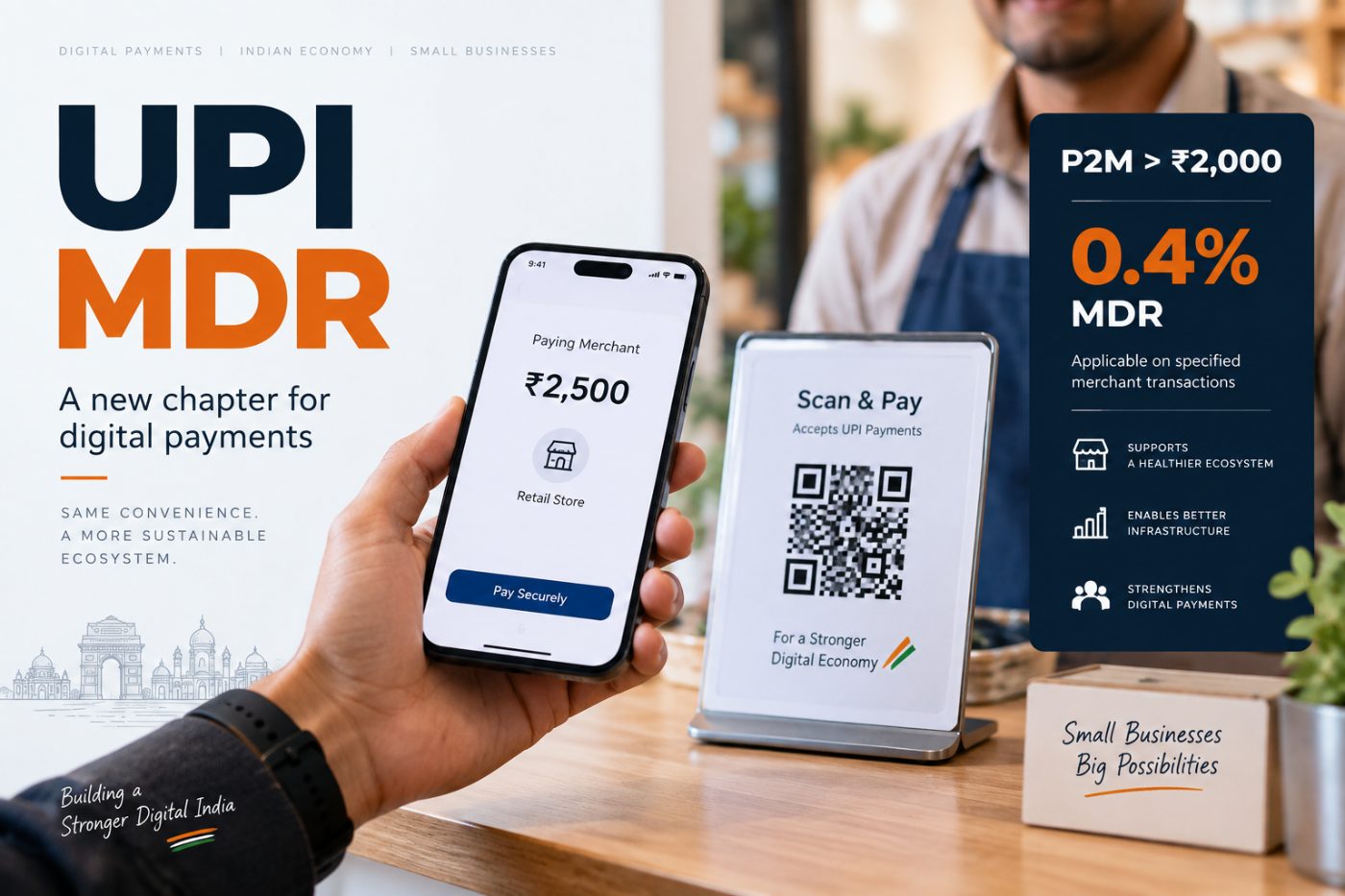
UPI MDR Charges: What the New 0.4% Rule Actually Means
For years, UPI's biggest attraction has been simple: scan a QR code, enter the amount, and pay without transaction charges.
That experience is not changing for consumers.
From October 15, 2026, however, a new Merchant Discount Rate (MDR) framework will introduce charges on certain Person-to-Merchant (P2M) UPI transactions. The important distinction is that the charge applies on the merchant side of the payment ecosystem, not to the person making the payment.
So, what exactly is changing?
Merchant Discount Rate (MDR) is a fee associated with processing a digital payment.
Under the new framework, an MDR of 0.4% applies to eligible P2M UPI transactions above ₹2,000.
For example:
₹2,000 payment → ₹0 MDR
₹3,000 payment → ₹12 MDR
₹50,000 payment → ₹200 MDR
₹1,00,000 payment → ₹300 MDR, because of the cap
For transactions of ₹75,000 and above, the MDR is capped at a maximum of ₹300 per transaction.
This means the fee doesn't keep increasing indefinitely with the transaction value.
Consumers Still Don't Pay for UPI
This is perhaps the most important point.
The new MDR framework does not make UPI a paid service for consumers. UPI remains free for people making payments, and the framework prevents merchants from adding the MDR as a surcharge to the customer's bill. Payment apps are also prohibited from imposing platform fees on these UPI transactions.
So, if you purchase something worth ₹5,000:
Customer pays → ₹5,000
The MDR is handled within the payment ecosystem rather than being added to the consumer's payment.
Most Everyday Payments Remain Outside MDR
The ₹2,000 threshold is central to the new framework.
All eligible commercial UPI payments of ₹2,000 or less remain under the zero-MDR regime.
This means many routine payments—such as groceries, food, small retail purchases and neighbourhood transactions—will remain unaffected.
According to the Ministry of Finance, approximately 96% of total merchant transactions will remain entirely unaffected by the levy because everyday merchant payments generally fall below the ₹2,000 threshold.
Small Merchants Are Also Exempt
The framework provides another important exemption for India's small-business ecosystem.
Eligible P2PM merchants receiving up to ₹1 lakh per month are exempt from the levy.
This is particularly relevant for neighbourhood vendors, small retailers and other micro-merchants that depend heavily on UPI QR payments.
The idea is to avoid putting an additional payment-processing burden on the smallest businesses while applying MDR primarily to larger commercial transactions.
Not Every Large Payment Will Face 0.4%
The standard 0.4% MDR isn't universal.
Certain sectors have been given separate slabs.
Transactions above ₹2,000 in specified sectors—including Indian Railways, fuel, telecom, insurance and agricultural inputs—will attract a flat ₹5 MDR instead of the standard 0.4% rate.
For example:
₹10,000 payment → ₹5 MDR
rather than ₹40 under a 0.4% calculation.
Payments related to mutual funds and equity brokerages carry a separate MDR of 0.02%, subject to a maximum cap of ₹300.
This creates a significantly lower rate for specified capital-market transactions.
Why Is MDR Being Introduced?
The reasoning behind the framework is closely connected to the enormous scale of India's digital-payment infrastructure.
UPI requires substantial investment in:
Cybersecurity
Server and network infrastructure
Fraud prevention
Payment reliability and uptime
Technical support
Continuous system upgrades
The MDR revenue is not a government tax. It is distributed among ecosystem participants, including issuing banks, acquiring banks and payment apps, with the stated objective of supporting the infrastructure and sustainability of the payment ecosystem.
The framework also includes a dedicated development fund intended to promote digital adoption and merchant onboarding in smaller towns and underserved areas.
What Happens From October 15?
The framework becomes effective on October 15, 2026.
The implementation window gives acquiring banks, payment aggregators, fintech companies and other ecosystem participants time to modify their billing, settlement and technical infrastructure.
The simplest way to understand the new system is:
Type of TransactionMDRP2M payment ≤ ₹2,000₹0Eligible P2M payment > ₹2,0000.4%Transactions ₹75,000+Maximum ₹300Selected sectorsFlat ₹5Capital markets0.02%, capped at ₹300Eligible P2PM merchants ≤ ₹1 lakh/month₹0Consumer UPI payment₹0
KEY TAKEAWAY
UPI is not becoming a paid service for consumers.
From October 15, 2026, eligible P2M transactions above ₹2,000 will generally attract a 0.4% merchant-side MDR, with the fee capped at ₹300 for transactions of ₹75,000 and above.
Payments of ₹2,000 or less remain at zero MDR, eligible small P2PM merchants remain exempt, and consumers cannot be charged the MDR as a surcharge.
Selected sectors have separate concessional rates, including a ₹5 flat fee and 0.02% for specified capital-market transactions.
The stated purpose is to create a sustainable funding mechanism for UPI infrastructure, cybersecurity, resilience and further digital-payment expansion.
The headline "UPI will now have charges" doesn't capture the entire framework.
The actual change is more specific: selected larger merchant-side UPI transactions will carry MDR, while the everyday consumer experience remains free.
For millions of people making small UPI payments, little changes. The major change happens behind the scenes, where banks, payment apps, aggregators and merchants will have to incorporate a new cost structure into eligible transactions.
Ultimately, the impact of this framework will depend on how effectively the ecosystem uses the additional revenue to maintain the reliability, security and scale that have made UPI one of India's most important digital-payment systems.
Comments (0)
No comments yet. Be the first to share your perspective.